
Ordering research peptides into Canada means clearing customs, not just clicking checkout. A parcel held at the border or a batch with no traceable test report leaves you with a stalled study and no paper trail.
This article covers what Kovagen supplies, whether direct Canadian ordering works, FedEx timelines and ambient-temperature packaging, and how customs documentation and Research Use Only status affect clearance. You will also learn how batch-level independent testing and 7-panel COAs are retrieved, what USD pricing means for Canadian buyers, and who should and should not order.
What Is Kovagen (KOVA)? Who It Serves and What It Supplies
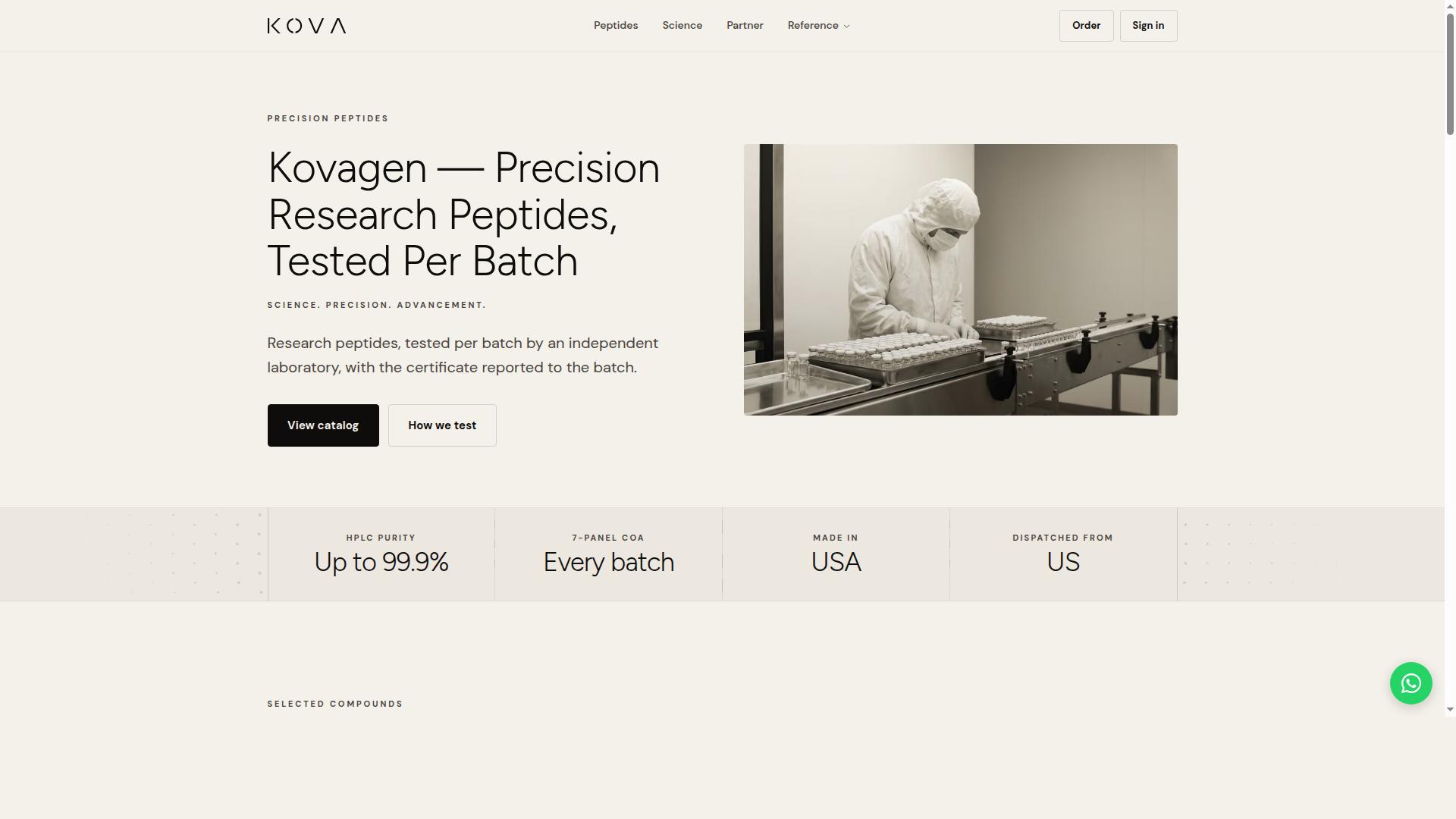
Kovagen (also called KOVA) is a research peptide supplier that sells lyophilized powder compounds and research supplies to laboratory researchers in the United States and Canada. The brand positions itself around a simple idea, summed up in its stated motto: "Science. Precision. Advancement."
That framing matters for anyone researching peptide suppliers online. Kovagen is explicit that evidence is the product. Every material it supplies is intended for laboratory research use only, not for human or veterinary consumption.
The catalog is compact rather than sprawling. Kovagen offers 30 compounds, made up of 22 single peptides and blends, all supplied as lyophilized powder. It also carries research supplies to support laboratory work with those compounds.
Lyophilized powder is the standard format for research peptides because the freeze-dried state supports stability during storage and transit. For researchers comparing vendors, a focused catalog of this size can make vendor verification simpler, since there are fewer product lines to check against certificates of analysis.
Kovagen's customer base is narrow by design. It serves laboratory researchers exclusively, and ships only to the United States and Canada. That geographic and audience focus is relevant to Canadian buyers weighing an online purchase, because it means the supplier is not a broad consumer storefront.
Each batch is tested by an independent analytical laboratory, according to the brand. For buyers who care about third-party lab testing and the purity certificate behind a batch, that per-batch approach is the detail worth noting when evaluating Kovagen as a source.
In short, KOVA is a research-focused peptide supplier with a defined catalog, a research-only scope, and batch-level analytical testing. Researchers in Canada looking for a supplier with a clear stated purpose will find that positioning easy to understand and easy to check.
Can You Buy Peptides Online in Canada From Kovagen? The Direct Answer
Yes, Kovagen ships research peptides to Canada, but Canadian buyers must understand the regulatory landscape before ordering. The short answer is that ordering is possible, yet the responsibility for compliant import sits with the buyer.
Kovagen serves the United States and Canada only. It cannot ship anywhere else at this time, so Canadian customers are within its supported service area.
Before placing an order, keep three points in mind:
- Health Canada regulations govern what may legally enter the country and how it is classified.
- Customs clearance is handled by the Canada Border Services Agency, and packages can be reviewed, delayed, or refused.
- Research use only status applies to these products. They are not medicines, supplements, or products for human consumption.
Kovagen supplies research chemicals, including lyophilized powder formats, to buyers who understand this research context. The company does not position its products for therapeutic or personal medical use.
Canadian buyers should also expect that a prescription requirement may apply to certain peptides under Canadian rules. Any item classified that way falls outside what an individual can legally import without proper authorization.
Because import regulations can change, verify the current status of any peptide with Health Canada before you complete an online purchase. Kovagen can ship to Canada, but it cannot advise on or guarantee customs outcomes on your behalf.
The details of shipping methods, customs procedures, and testing documentation are covered in the sections that follow. This section answers only the core question: yes, Kovagen ships to Canada, and Canadian buyers carry the duty of regulatory compliance.
Shipping to Canada: Timelines, Carriers and Temperature Handling
Kovagen uses FedEx 2Day for all U.S. orders and dispatches by the next business day, but Canadian shipments may involve different carriers and timelines. The company does ship to Canada, and Canadian orders travel via FedEx International, typically arriving within 3 to 7 business days, subject to customs.
Two factors shape the experience for Canadian buyers: customs clearance and temperature control. A parcel can move quickly through the courier network and still sit at a border facility, so planning around the upper end of the delivery window is sensible.
Peptides are sensitive to heat, light and moisture, which makes packaging and transit conditions worth understanding before you order. Kovagen states that shipments travel at ambient temperature, and the sections below break down dispatch windows, carrier options and what to expect when the parcel arrives.
FedEx International Delivery and Dispatch Windows
For U.S. orders, Kovagen dispatches by the next business day via FedEx 2Day, and Canadian orders likely follow a similar expedited pattern with FedEx International. Dispatch is tied to payment: an order moves once payment clears, so the clock starts from confirmation rather than from the moment you click submit.
Expect the following rough windows when planning an online purchase:
- United States: 2 to 3 business days after dispatch via FedEx 2Day
- Canada: typically 3 to 7 business days via FedEx International, subject to customs
- Tracking: a tracking number is provided so you can follow the parcel through each stage
The Canadian range is wider because customs clearance sits between dispatch and delivery. CBSA can hold a shipment for inspection, and that time is outside the courier's control. A parcel that clears in a day and one that takes a week can both fall inside the normal range.
Buyers should build a buffer into any timeline, especially when a vial or bacteriostatic water is needed by a particular date. Ordering earlier than you think necessary is the simplest protection against border delays. Tracking updates will show when a parcel enters customs and when it is released, which helps you distinguish a slow clearance from a genuine delivery problem.
Ambient-Temperature Transit and Packaging Expectations
Lyophilized peptides are generally stable at ambient temperatures, but proper packaging is essential to protect them from moisture, light, and temperature fluctuations during transit. The lyophilized powder form is far more forgiving than a reconstituted peptide, which is why suppliers ship it dry and leave reconstitution to the buyer.
Typical packaging for this kind of shipment includes:
- Sealed vials that protect contents from air and contamination
- Desiccant to absorb moisture inside the packaging
- Insulated mailers to buffer short-term temperature swings
A full cold chain is not usually required for lyophilized peptides. What matters more is avoiding extremes, such as a parcel left in direct summer sun or a freezing mailbox in winter. Insulated mailers help with brief exposure but cannot compensate for hours in harsh conditions.
Inspect the package as soon as it arrives. Check that vials are intact, that the powder looks as expected, and that nothing appears damp. Then store the peptides as directed, refrigerated or frozen depending on the product, and keep them away from light. If a parcel arrives visibly damaged or delayed in extreme weather, document the condition before opening anything further.
Customs and Import: What Canadian Researchers Should Understand
Importing research peptides into Canada involves navigating customs procedures, potential duties and taxes, and ensuring compliance with Health Canada regulations. Buyers should treat every order as a regulated import, not a routine parcel, and plan accordingly.
Shipments entering the country may be inspected by the Canada Border Services Agency (CBSA). When a parcel is selected for review, clearance can take longer than the usual delivery window, and the buyer may be asked to supply supporting paperwork.
Duties and taxes can also apply depending on how the goods are classified and valued. These charges are separate from the purchase price and are typically the importer's responsibility, so it helps to budget for them before ordering.
The most important point is that the buyer carries responsibility for compliance. That means knowing which peptides are permitted, whether a prescription requirement applies, and whether the intended use is legitimate under Canadian rules. Kovagen supplies products for research use only, a designation that shapes how a shipment may be treated at the border. The subsections below break down documentation, traceability, and the practical effect of that research-use label.
Documentation, Declarations and Batch Traceability
Kovagen includes a certificate of analysis (COA) with each batch, which can serve as documentation for customs and regulatory purposes. The COA is tied to a specific batch number, so the paperwork you hold can be matched to the exact product in the parcel.
This traceability matters because it shows the material was tested and identified. Kovagen uses independent analytical laboratories, not in-house testing, and publishes a 7-panel COA for every batch. Certificates are retrievable by batch number without an account, which makes verification straightforward for a buyer or an inspecting officer.
Keep your COAs on file after delivery. If customs requests documentation, you can present the certificate alongside your order records to confirm what was shipped and how it was tested.
Customs declarations typically describe the goods as research chemicals or peptides for laboratory use. Accurate declarations reduce the risk of delays caused by mismatched paperwork.
Note that Kovagen does not provide import licenses or regulatory advice. Buyers must ensure their own compliance with Canadian import regulations, including any permits or authorizations their situation requires.
Why "Research Use Only" Status Matters at the Border
Labeling peptides as "research use only" is critical because it signals that the products are not intended for human consumption, which can influence how customs and health authorities treat the shipment. The designation may exempt products from certain pharmaceutical regulations, but it also places responsibility on the buyer to use them appropriately.
Health Canada may flag shipments if they appear to be for personal use or if the peptides involved appear on a prohibited list. A parcel that looks like a personal supply, rather than laboratory material, is more likely to attract scrutiny.
Buyers should therefore know which peptides are restricted before ordering and be able to explain the legitimate research context for the purchase. Keeping documentation consistent with that context supports a smoother customs clearance process.
- Confirm the peptides you intend to import are not prohibited in Canada.
- Understand whether a prescription requirement applies to your situation.
- Keep batch-level COAs and order records available for inspection.
- Ensure the declared research purpose matches how the material will actually be used.
The research-use label is not a loophole. It is a statement of intended purpose, and authorities expect the buyer to honor it. Products such as lyophilized powder are supplied for laboratory work, and the buyer's own regulatory compliance remains the deciding factor in how smoothly an import proceeds.
Testing Explained: Independent Lab Analysis and COAs
Every batch of Kovagen peptides is tested by an independent analytical laboratory, not in-house, to verify identity and purity. This separation matters because a supplier testing its own product controls both the sample and the result. An outside lab removes that conflict.
For buyers in Canada, where import regulations and Health Canada oversight make vendor verification essential, documented testing is one of the few concrete signals available before an online purchase. A purity certificate backed by third-party lab testing turns a claim into something a buyer can check.
Kovagen publishes a certificate of analysis (COA) per batch, and each one can be retrieved by batch number without an account. That means a buyer does not have to request documents by email or wait on a support reply to see results.
Each COA covers the tests that matter for a lyophilized powder: HPLC analysis for purity, mass spectrometry for identity, and additional panels described below. The sections that follow break down what those tests measure and how to pull the certificate for your specific vial.
HPLC Purity Up to 99.9% and the 7-Panel COA
Kovagen's peptides are analyzed via HPLC to confirm purity levels up to 99.9%, and each COA includes a 7-panel test covering appearance, identity, purity, and more. HPLC, or high-performance liquid chromatography, separates the compounds in a sample and measures how much of the material is the target peptide versus related impurities. The result is reported as a percentage.
It is worth reading that figure carefully. Purity up to 99.9% is achievable, but not every batch will reach that ceiling, and a COA should be read as the actual result for that batch rather than a guaranteed number. A certificate showing a slightly lower figure with full documentation is more useful than an unverified claim of perfection.
The 7-panel COA typically covers:
- Appearance, confirming the physical form of the lyophilized powder
- HPLC purity, the percentage of target peptide in the sample
- Mass spectrometry identity, confirming the compound's molecular mass matches the expected structure
- Water content, relevant to stability of a lyophilized product
- Peptide content, the actual amount of peptide present
- Endotoxin test, a safety indicator
- Sterility, confirming the batch meets microbiological standards
Together these panels give a reader full transparency on what was measured and what the numbers were. Identity testing via mass spectrometry is especially important, since a pure sample of the wrong compound would still show a high HPLC figure.
Retrieving a Certificate by Batch Number Without an Account
Customers can retrieve the certificate of analysis for any batch by entering the batch number on Kovagen's website, with no account registration required. The process takes a few steps:
- Locate the batch number printed on the vial label
- Open the COA lookup page on the Kovagen website
- Enter the batch number exactly as shown
- Download the PDF certificate for that batch
No login, no email request, and no waiting period. Anyone holding a vial, whether they bought it directly or received it another way, can confirm what testing was performed on that specific batch.
This matters for regulatory compliance awareness as much as for quality. Buyers in Canada navigating import regulations and customs clearance benefit from having documentation ready, and a downloadable PDF is easy to keep on file. It also supports transparency and trust in a market where grey market sellers often provide nothing at all.
The barrier-free design is deliberate. When verification requires an account or a support ticket, most buyers skip it. Making the certificate a few clicks away means the testing claim can be checked by anyone, at any time, against the exact batch in hand.
Pricing in USD: What Canadian Buyers Can Expect to Pay
Kovagen lists prices in USD, so Canadian buyers should account for exchange rates and potential foreign transaction fees when budgeting. Every figure shown on the product pages is denominated in US dollars, not Canadian dollars.
That distinction matters at checkout. Your card issuer or payment processor will convert the charge into CAD at its own rate, and the final amount on your statement may differ from the listed figure. Budget a buffer above the sticker price so the converted total does not catch you off guard.
To give you a realistic picture, here are several current examples from the Kovagen catalogue:
| Product | Size / Composition | Price (USD) |
|---|---|---|
| Retatrutide (GLP-3) (Reta) | From $95.00 | $95.00 |
| BPC-157 | 10mg | $80.00 |
| GHK-Cu | From $55.00 | $55.00 |
| Wolverine (BPC-157 / TB-500) | 10/10 | $140.00 |
| TB-500 Thymosin Beta-4 (Long Chain) | 10mg | $85.00 |
| Klow (GHK-Cu / TB-500 / BPC-157 / KPV) | 50/10/10/10 | $175.00 |
| CJC-1295 No DAC / Ipamorelin | 5/5 | $85.00 |
| MOTS-c | 20mg | $160.00 |
| Tesamorelin | 10mg | $110.00 |
| Glow (GHK-Cu / TB-500 / BPC-157) | 50/10/10 | $145.00 |
| BAC Water | Single vial | $15.00 |
The spread shows how widely costs vary by compound and vial size. A single-vial item like BAC Water at $15.00 sits at the low end, while larger multi-peptide blends climb well above $150.00. Buyers comparing peptide suppliers should weigh the price against vial size, not the headline number alone.
Before completing an online purchase, check with your bank about foreign transaction fees and the exchange rate it applies. Some cards waive these charges entirely, which can meaningfully lower your effective cost. It also helps to confirm whether your issuer treats the transaction as international.
One practical tip: factor the full landed cost into your budget, including any conversion markup. A peptide that looks affordable at the listed USD price can cost noticeably more once the CAD conversion and bank fees settle. Comparing a few items side by side in the same currency keeps your budgeting consistent.
Trust Signals: Made in USA, Dispatched From the US, Per-Batch Verification
Kovagen's products are made in the USA and dispatched from the United States, with every batch verified by an independent lab and accompanied by a publicly retrievable COA. For Canadian buyers weighing peptide suppliers, that combination of origin, logistics and documentation answers the questions that matter most before an online purchase.
Manufacturing in the USA places production under a well-understood regulatory environment. The identity of Kovagen's manufacturing partner is confidential and not published, which is common in this market. What matters for vendor verification is that the country of manufacture is stated openly rather than left vague.
Dispatch from the US also affects shipping to Canada. Orders travel via FedEx International and typically arrive in 3 to 7 business days, subject to customs. That is often faster than overseas suppliers, where transit times stretch longer and cold chain or temperature control concerns grow with every extra day in transit.
Each batch is tested by ILS Laboratories in San Diego, California, and the resulting COA is available online. Buyers can check purity certificate data for the exact batch they receive rather than relying on a generic spec sheet. Batch traceability of this kind is what separates transparent vendors from the grey market.
Kovagen also runs a partner program: 25% on each referred new customer's first eligible order, then 10% on their eligible repeat orders for life. A standing program like this signals confidence in retention, since repeat commissions only pay off if customers come back.
The site does not publish customer reviews or star ratings, so third-party lab testing and public COAs carry the trust burden instead. For Canadian shoppers, that documentation is the most useful signal available when comparing peptide suppliers.
Who Should Buy From Kovagen - and Who Should Not
Kovagen is intended for laboratory researchers who require research-grade peptides for in vitro studies, not for individuals seeking personal use or human consumption. The distinction matters because every product Kovagen supplies is sold strictly for laboratory research purposes. Buyers should approach the catalogue as a source of research chemicals, not as a place to source anything intended for the human body.
Understanding this boundary before placing an order protects both the buyer and the integrity of the research. Kovagen serves a defined research audience, and the products are labeled and supplied accordingly. Anyone whose needs fall outside that scope should look elsewhere.
The profiles below outline who fits the Kovagen model well and who should not buy from the store. Use them as a quick self-check before browsing the catalogue or completing an online purchase.
Who should buy from Kovagen:
- Professional researchers running controlled in vitro experiments who need reliable research-grade materials.
- Laboratories with established protocols for handling and storing peptides, including lyophilized powder and any reconstitution supplies such as bacteriostatic water.
- Institutions that require documentation like a purity certificate or COA and understand how to interpret third-party lab testing, HPLC analysis, and mass spectrometry results.
- Buyers who understand Canadian import regulations and accept responsibility for regulatory compliance on their end.
- Teams equipped for proper storage, including temperature control and cold chain practices where a product requires them.
These buyers typically know what a vial contains, how to read a COA, and why purity documentation matters to reproducible work. They treat every order as a research purchase with defined handling requirements from arrival onward.
Who should not buy from Kovagen:
- Individuals seeking therapeutic or personal use, including anyone asking about dosage or human consumption.
- Buyers unfamiliar with Canadian import regulations who have not reviewed how customs clearance, duties, and taxes apply to their shipment.
- Anyone expecting pharmaceutical-grade products for human use. Kovagen supplies research materials only.
- People without proper storage capability, since mishandling a peptide after delivery can compromise the material.
- Those unwilling to accept compliance responsibility for their own purchase and its import.
If any item on the second list describes your situation, Kovagen is not the right supplier. The store does not position its products as suitable for those purposes, and no order should be placed with that expectation.
The clearest way to decide is to ask one question: is this purchase for laboratory research, handled by someone who understands research chemicals and their storage? If yes, Kovagen fits. If the answer involves personal use, therapeutic goals, or uncertainty about Canadian rules, it does not.
Kovagen sells for research purposes only, and buyers carry responsibility for compliance with the regulations that apply to them. That model works best with researchers who already operate within a structured lab environment and value clear documentation over convenience. For that audience, Kovagen is a legitimate and appropriate source. For everyone else, the honest answer is to buy elsewhere.
Final Verdict: Is Kovagen a Reliable Way to Buy Peptides Online in Canada?
Kovagen offers a transparent, testing-focused approach to buying research peptides online in Canada, but reliability depends on the buyer's ability to navigate import regulations. The supplier provides per-batch independent testing, accessible COAs, and competitive USD pricing. For laboratory researchers who understand the landscape, that combination makes Kovagen a dependable option.
The strengths are straightforward. Kovagen ships to Canada and backs each batch with third-party lab testing, so a purity certificate and COA documentation are within reach for verification. Pricing is set in USD, which keeps comparisons clear for buyers who already account for exchange rates and shipping costs.
The challenges are equally real. Any online purchase crossing the border faces customs clearance through the CBSA, potential duties and taxes, and the need for regulatory compliance on the buyer's side. Research chemicals can be held or refused if paperwork or declarations fall short. Buyers should confirm their own compliance before ordering.
For contact and questions, Kovagen responds by email at contact@kovagen.com within one business day. The team is also reachable on WhatsApp at +1 619 335 7514. The postal address is Hybrid Tech Rainbows LLC, 30 N Gould St, STE R, Sheridan, WY 82801, United States.
The verdict: Kovagen is a reliable route for laboratory researchers who verify their own import obligations, confirm local rules, and treat documentation as part of the purchase. Reach out with questions before ordering, and check your compliance first.
Frequently Asked Questions
Does Kovagen ship peptides to Canada, and how long does delivery take?
Yes - Kovagen (KOVA) ships to Canada as well as the United States, and cannot ship anywhere else at this time. Kovagen uses FedEx 2Day for every U.S. order and dispatches by the next business day after payment; for Canadian orders, contact the team at contact@kovagen.com to confirm current shipping arrangements before you buy.
Will my peptide order get held at Canadian customs?
Import rules and clearance decisions are made by Canadian customs authorities, not by the supplier, so no vendor can guarantee an outcome - this is why it's worth understanding the rules before ordering. Kovagen supplies its peptides strictly for laboratory research use only (not for human or veterinary consumption), and you can email contact@kovagen.com with any shipping or documentation questions before placing an order.
How do I know the peptides I buy are actually tested?
Every Kovagen batch is tested by an independent analytical laboratory - not in-house - with HPLC purity up to 99.9% and a 7-panel COA. Certificates of analysis are published per batch and retrievable by batch number without needing an account, so you can verify the specific batch you receive.
What does a certificate of analysis (COA) tell me, and how do I access one?
A COA documents the independent lab results for a specific batch, including purity and the panel of tests performed. With Kovagen, each certificate is tied to its batch and can be looked up by batch number on the site without creating an account - keep your batch number so you can retrieve the matching COA.
What forms and products does Kovagen offer, and how much do they cost?
Kovagen stocks research peptides as lyophilized powder, including single compounds and blends, alongside research supplies; the catalog lists 30 compounds (22 single peptides and blends). Prices are in USD - for example, BPC-157 10mg is $80.00, GHK-Cu starts from $55.00, and Retatrutide (GLP-3) starts from $95.00.
Who can I contact at Kovagen if I have a question about shipping or an order?
Email contact@kovagen.com - the team responds within one business day - or reach them via the WhatsApp chat link on the site (+1 619 335 7514). Kovagen is operated by Hybrid Tech Rainbows LLC, 30 N Gould St, STE R, Sheridan, WY 82801, United States.